
Finnish authorities have launched a major gambling reform with the launch of a Finnish license.. Authorities launched a comprehensive reform designed to open the market and replace the long-standing monopoly model. The government introduced the reform bill in March 2025, Parliament approved the new Gambling Act on December 16, 2025, and the President signed it into law on January 16, 2026.
The legislation ends Veikkaus’ exclusive control over online betting, slots, and casino games. At the same time, the company retains exclusive rights to lotteries, scratch cards, and land-based gaming machines until June 30, 2027. This transitional structure allows the market to gradually adapt to the new competitive environment. The regulatory framework establishes a two-tier licensing system. One licence category applies to gambling operations, covering B2C operators offering betting, slots, and online casino products. The second category focuses on gambling software, introducing mandatory B2B licensing starting in 2028. Finnish license remains valid for a maximum of five years. The reform also introduces a 22% tax on Gross Gaming Revenue (GGR), aligning Finland with widely used European taxation models.
Finnish License: New Regulatory Framework
Finland is reshaping its gambling oversight structure. Authorities will transfer licensing and enforcement responsibilities from the National Police Board to a newly established Finnish Licensing and Supervisory Authority. The regulator will operate on a self-funded model supported by licence fees and annual supervisory payments. Its mandate will cover licence approvals, operator monitoring, action against illegal websites, and the handling of player complaints.
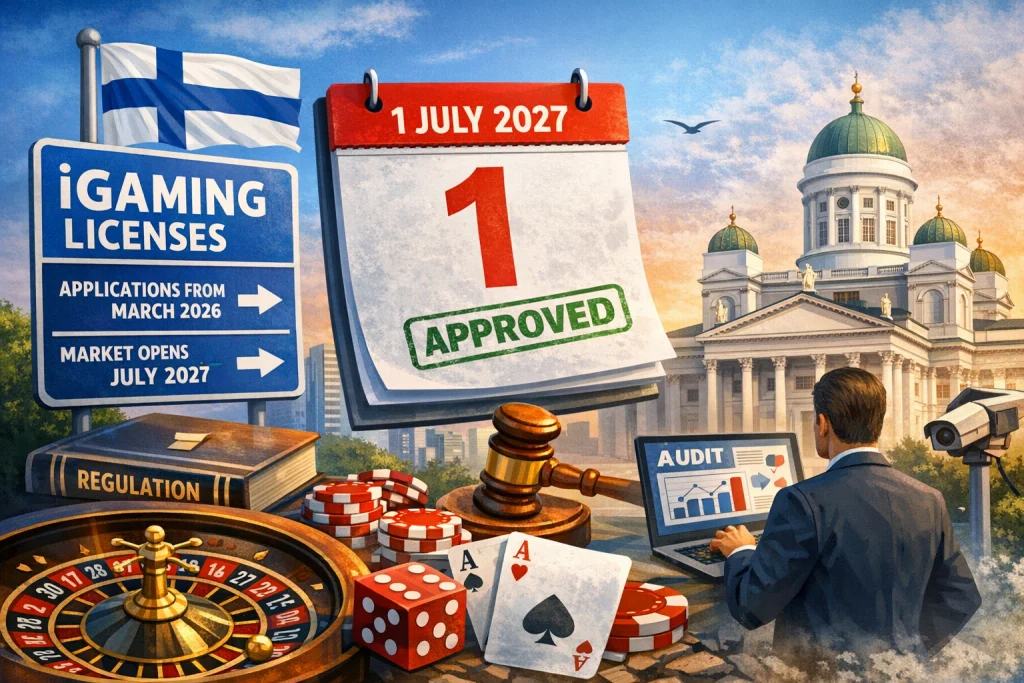
The licensing timeline already provides a clear roadmap for market participants. Applications for B2C licences will open on March 1, 2026. The regulated iGaming market will officially launch on July 1, 2027. On the same date, authorities will begin accepting B2B licence applications for gambling software providers. Mandatory B2B licensing requirements will take effect on July 1, 2028. The regulator will start formally reviewing submitted licence applications on March 1, 2027.
Technical and Legal Requirements
The new Finnish License introduces strict rules for licensed operators:
- AML/KYC. Mandatory verification of identity and age at registration, continuous payment monitoring, and reporting of suspicious activity.
- Responsible gambling. Players must set personal limits on deposits and losses, while operators must implement self-exclusion tools and systems that monitor risky behavior. The reform also introduces a unified self-exclusion register that allows players to block themselves across all licensed operators.
- Cybersecurity implementation. Operators must undergo regular information security audits and RNG (random number generator) testing. Independent experts will review source code and RNG algorithms, as well as conduct fairness testing.
The framework introduces limits on bet sizes, spin speed, autoplay features, and mandatory breaks. Licensed operators may accept only players who permanently reside in Finland, while the use of cryptocurrencies for payments remains prohibited.
One of the most significant aspects of the reform is the introduction of strict advertising restrictions, which differ notably from the systems used in Sweden and Denmark. Key provisions include:
- Full ban on affiliate and influencer marketing via third parties. Licensed operators may place advertising only on their own platforms.
- Advertising moderation. Regulators allow advertising only in a “moderate form.” The rules prohibit operators from targeting minors, using interactive social media formats, or involving celebrities and influencers outside their own channels. The framework allows television, radio, and print advertising.
- Direct marketing requirements. Operators may promote services via email or SMS only after obtaining explicit customer consent.
Finnish law effectively prohibits welcome bonuses, free spins, cashback, and loyalty programs. Only moderate bonus credits for existing customers are allowed. Such bonuses must not be tied to deposits or losses and must include minimal wagering requirements.
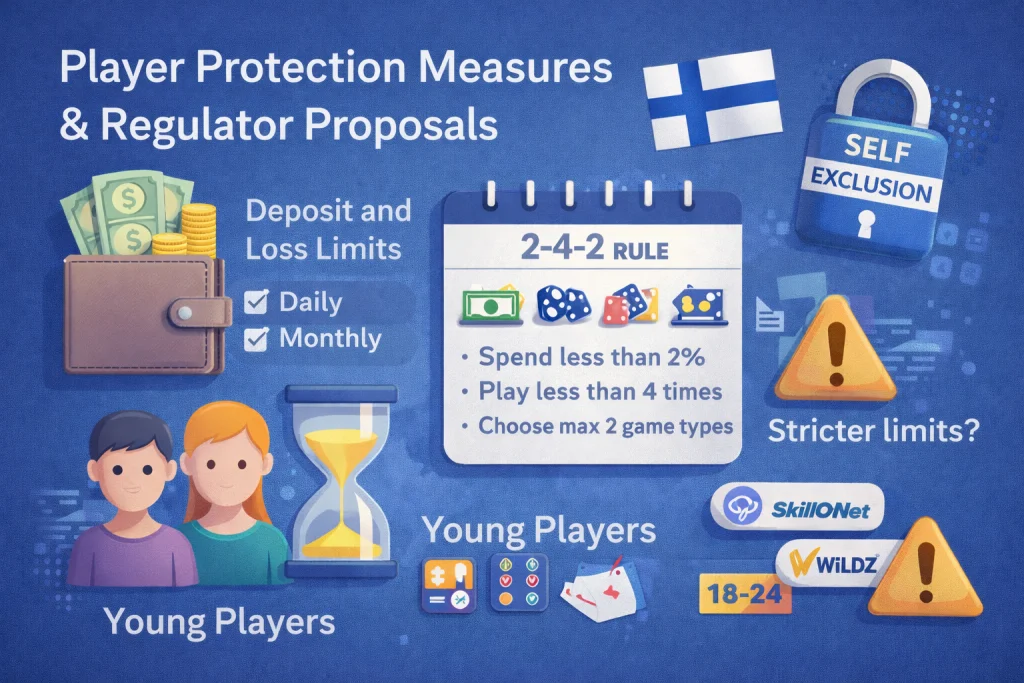
Player Protection Measures and Regulatory Proposals
Finnish authorities place strong emphasis on addiction prevention. Among the discussed and adopted measures:
- Mandatory limits. Each player must set daily and monthly limits for every operator. Regulators are also considering a centralized limit registry that would cap the total amount a player can lose across all operators.
- The “2-4-2 rule” from THL. In February 2026, THL issued recommendations: spend no more than 2% of net monthly income on gambling, play no more than four times per month, and engage with no more than two types of games.
- Self-exclusion. Players will be able to block themselves from all licensed operators via a central registry. Operators must provide self-exclusion tools and cooling-off options.
- Youth safeguards. Separate measures for players aged 18–24 are under discussion, including lower limits and enhanced verification procedures.
Some operators have criticized the potential introduction of strict limits. SkillOnNet and Wildz argue that rigid deposit and loss caps may push players toward unlicensed platforms. Industry analysts suggest prioritizing enforcement against illegal operators and simplifying registration procedures to help retain players within the regulated market.
Economic Rationale of Finnish License
Finland decided to open its market because roughly half of online gambling activity currently takes place through foreign operators, which leads to an estimated annual tax revenue loss of €150–250 million. Analysts value the total gambling market at approximately €2.4 billion. Following the market opening scheduled for July 2027, regulators expect between 30 and 50 international operators to enter.
Webinar “How Finland Is Different”
Amid anticipation of secondary regulations and technical standards, Gaming in Finland announced a webinar titled “How Finland Is Different.” The event is scheduled for March 5, 2026. Its objective is to explain how the Finnish regulatory model differs from the systems used in Sweden and Denmark, while helping prospective license applicants prepare for submission.
Speakers
Registration for the webinar is already open, and the event is positioned as the first platform to discuss specific application requirements. Confirmed participants include Morten Ronde and Pekka Ilmivalta. Willem van Oort, founder of Gaming in Finland, will moderate the session. He emphasized that the organizers deliberately scheduled the webinar one to two weeks after the publication of the secondary regulations to provide practical guidance.
Economic Rationale of Finnish License Final Remarks
Finland stands on the brink of significant changes in its gambling sector. The legislative reform has brought an end to Veikkaus’ long-standing monopoly and aims to establish a transparent, competitive, and socially responsible market. The licensing process is scheduled to begin on March 1, 2026, while the market is set to open to players on July 1, 2027. However, the high threshold for advertising restrictions, the rejection of affiliate models, and the introduction of strict limits have raised industry concerns and sparked debate over player retention within the regulated sector.