

In January 2026, Google finally did what had been brewing for the past couple of years: it turned gambling advertising into an ultra-high-responsibility vertical. Now it’s not just the operators themselves feeling the heat — the agencies handling their budgets are also squarely in the firing line.
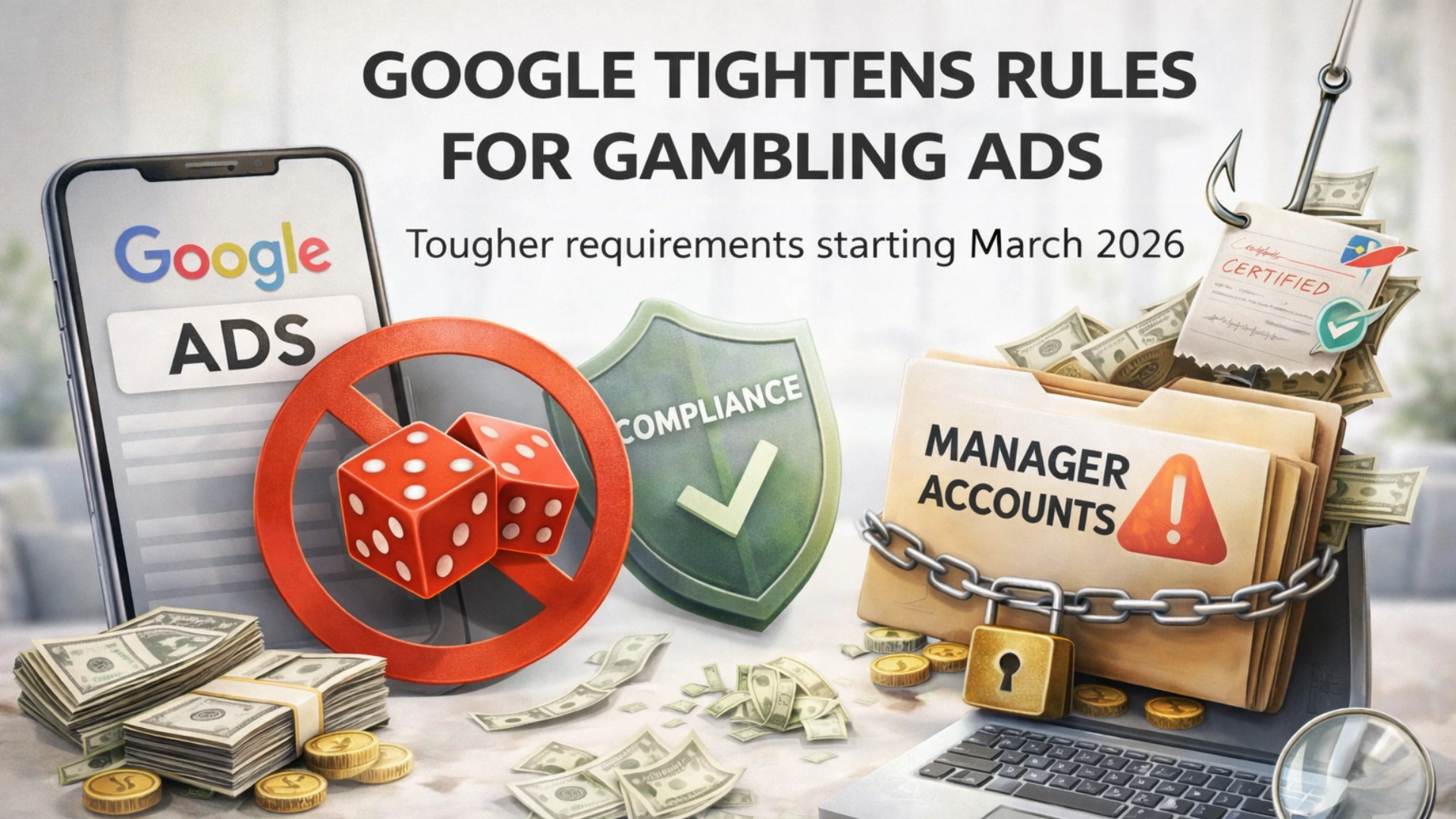
On 22 January, the Gambling & Games policy received a major update — and it’s genuinely strict. Access to Google Ads in this vertical has become much more restricted, and the entire certification system has been turned upside down.
The changes officially take effect on 23 March 2026, but it’s already clear: the iGaming market is in for a serious shake-up.
Comprehensive Account Reputation Check
The biggest new requirement is the mandatory “good policy health” standard. From now on, any account wishing to run ads in the gambling and betting categories must prove a spotless history of compliance with Google’s advertising policies.
Previously, certification was largely about confirming a valid licence and jurisdictional compliance. Now Google is assessing the account’s behaviour over time. The factors taken into account include:
- Violation history
- Instances of certificate revocation
- Recurring incidents
- Overall state of the advertising profile
Google has not published any specific quantitative thresholds or metrics that determine an account’s “trustworthiness”. This gives the platform significantly wider discretionary power when deciding whether to grant — or revoke — certification.
Hit to Agencies: Collective Responsibility
The most painful change affects Manager Accounts (MCCs) — the agency and media-buying structures that manage multiple clients.
If a manager account is found to have a significant number of clients with revoked certificates or repeated gambling policy violations, Google can now:
- Block applications for new certificates
- Revoke existing certificates
- Effectively shut the agency out of the vertical entirely
Agencies are no longer judged solely on individual projects — they are now accountable for the overall cleanliness of their entire client portfolio.
This creates a cascading effect: a violation by just one client can jeopardise the agency’s ability to work with all the others. For larger iGaming agencies this means they will need to implement serious internal compliance audits, much stricter client filtering, and ongoing monitoring of operators’ domains and licences.
Domain Infrastructure Under the Microscope
The second major pillar of the update is the much sharper focus on domain requirements. Google is reiterating — and now enforcing more aggressively — that certification will be refused if the site:
- Is hosted on free or shared hosting platforms
- Uses a third-party subdomain
- Shows no clear connection to legitimate, licensed gambling activity
- Operates on a second-level domain that does not belong to the advertiser
While these rules technically existed before, the January update elevates them to a standalone red flag. The reason is straightforward: over the past few years, Google has repeatedly dealt with attempts to circumvent requirements through throwaway domains, generic hosting services, and convoluted subdomain setups.
Regional Context and Regulatory Pressure

The new rules hit particularly hard for anyone driving traffic into Europe, the Middle East, and Africa (EMEA). This is exactly the region where regulators have been cracking down aggressively on unlicensed offshore operators in recent times.
Italy maintains a blanket ban on gambling advertising. In Germany and the United Kingdom, authorities routinely target promotion of platforms lacking a local licence. Several other EU countries are currently in active discussions about introducing fresh restrictions specifically on digital iGaming marketing.
As the world’s largest global advertising platform, Google is increasingly acting as a de facto “filter” — largely to protect itself from regulatory headaches and hefty fines. That’s why the screws are being tightened: certification now depends not only on holding a valid licence, but also on the overall “health” of the account, violation history, and even the behaviour of every sub-account under a manager dashboard.
The Harshest Sanctions in the Google Ads System
Gambling remains one of the most tightly controlled verticals inside Google Ads.
Breaches in this category are classified as egregious violations. In many cases they can trigger immediate account suspension with no prior warning. For certain sub-categories — including social casinos — sanctions can be permanent and irreversible.
What This Means for the Market
For operators:
- Far greater attention must be paid to domain structure and proper legal setup
- Consistent, long-term policy compliance becomes non-negotiable
- Any grey-area experimentation is now significantly riskier
For affiliates:
- Working through agencies with a “dirty” track record can backfire badly
- Transparent domain ownership and a clear legal link to the operator are now essential
And for agencies:
- Strong compliance turns into a genuine competitive edge
- Portfolio management becomes a core strategic risk issue
- We may see market consolidation around fewer, more robust and “clean” structures
It’s worth remembering: the January update isn’t an isolated event. Throughout 2024–2025, Google had already been tightening re-certification procedures, adding extra layers of scrutiny, and temporarily freezing new applications in selected jurisdictions. Now the emphasis has decisively shifted from “do you have a licence?” to “how do you behave?”.
In Summary
The tightening of gambling advertising rules in Google Ads represents a clear move towards a more mature, controlled, and accountable advertising environment. The platform is strengthening oversight, extending liability to manager accounts, and making clean domain infrastructure a non-negotiable prerequisite.
For the iGaming market, this marks a transition from “access by licence” to “access by trust”. In 2026, the players who get to advertise aren’t simply those with the biggest budgets — they’re the ones with the strongest, cleanest reputation.