
The 2025/26 season marks the end of an era for the Premier League. It’s the last year clubs can run out with bookmakers’ logos plastered across their chests. From next season onwards, there’s a voluntary agreement to ditch them completely.
This isn’t a total divorce from the betting industry — just a very visible restriction on the single most eye-catching bit of sponsorship. Still, that front-of-shirt logo has been the biggest advertising real estate in football for decades.
How Much Cash Betting Sponsorship Brings to Premier League Clubs
People often underestimate just how big the betting sponsorship money is in the Premier League. When you’ve got billions rolling in from TV rights, those front-of-shirt deals can look like small change. But for a decent chunk of clubs, they’re actually a massive part of their commercial income.
$129.6 Million for Front-of-Shirt Deals: the Scale of It
Industry estimates put the total haul from gambling operators for front-of-shirt placement at roughly $129.6 million. That’s a hefty slice of the league’s non-broadcast, non-matchday commercial revenue.
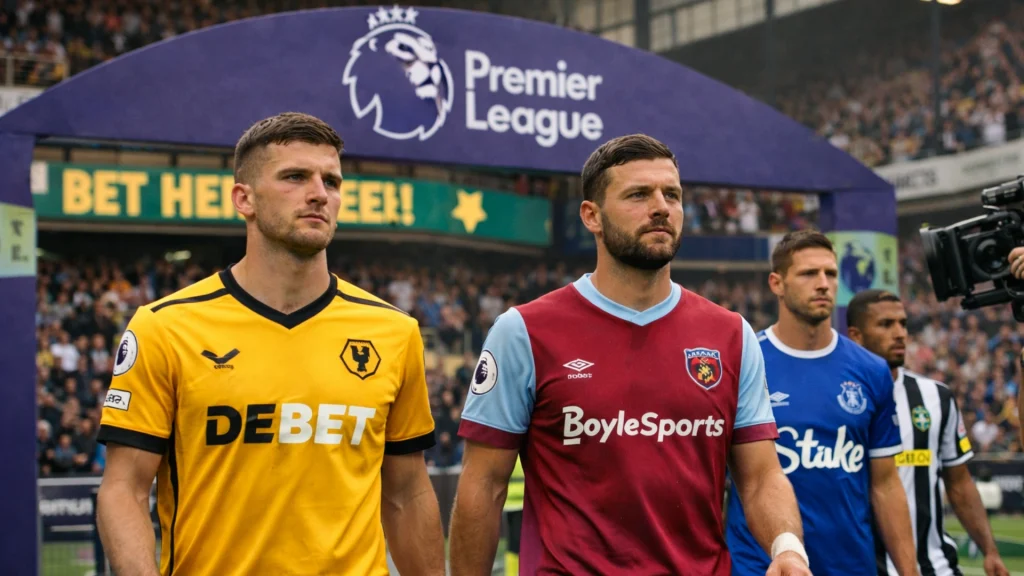
11 out of 20 Clubs Sporting Betting Logos
In 2025/26, 11 of the 20 Premier League sides took the pitch with a bookmaker’s brand front and centre. Altogether, gambling makes up about 23% of the entire front-of-shirt sponsorship market.
Why 23% Isn’t “Small Beer” at All
At first glance, a quarter of the market sounds nicely spread out. But the average hides a huge imbalance: the reliance is massively skewed and hits hardest outside the top six.
The Tale of Two Leagues
The betting logo ban won’t affect every Premier League club the same way. The rule applies across the board, but the financial fallout depends entirely on how each club makes its money. Truth is, the Premier League has operated like two different leagues for years — the “Big Six” and everyone else.
The Big Six: Betting as a Nice-to-Have
For the likes of Arsenal, City, United, Liverpool, Chelsea and Spurs, betting sponsorship is just one option among many. Their commercial portfolios are nicely diversified — tech giants, global banks, airlines, electronics brands — all bringing in steady, serious money.
Losing a bookie deal? Annoying, but hardly existential. They can manage it.
Clubs Outside the Top Six: Sponsorship as a Lifeline
It’s a completely different story for the rest. In this group, gambling operators dominate as they account for nearly 79% of all front-of-shirt placements and over 72% of the total value.
30–38% of Commercial Revenue: a Proper Dependency
For some of these clubs, betting deals make up 30–38% of their entire commercial income. When the most prominent (and valuable) format disappears, it’s not just a dip. It means lower-value contracts, budget headaches, and a proper scramble to plug the gap.
Premier League’s Gambling Restriction: What’s Actually Banned
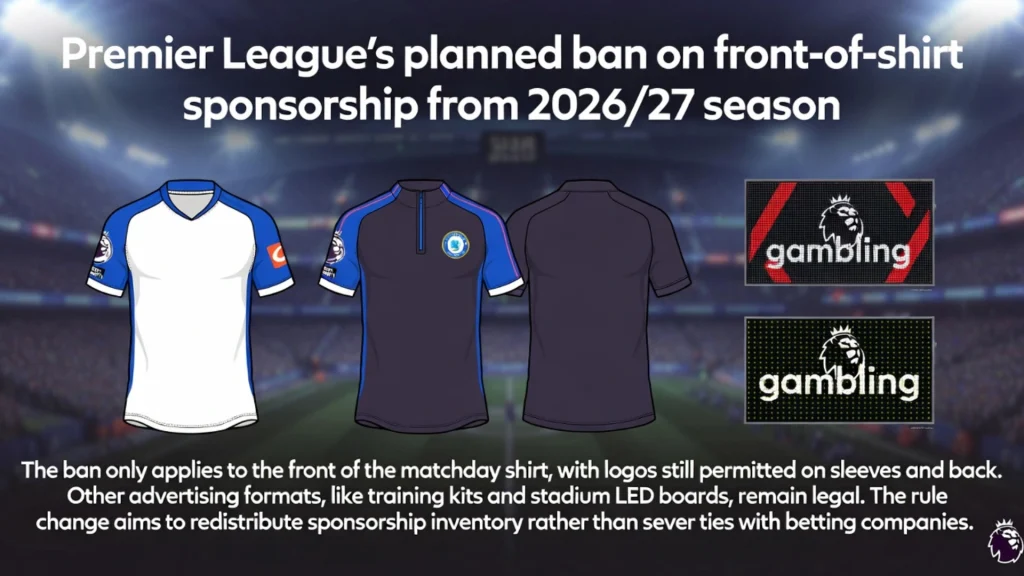
For all the dramatic language, this is a very precise, targeted measure. The Premier League isn’t ending its relationship with the betting industry completely. It’s simply banning the single most prominent and eye-catching advertising space: the primary front-of-shirt sponsor logo.
The Ban Applies Only to the Front of the Matchday Shirt
Starting from the 2026/27 season, clubs will no longer be allowed to place bookmaker logos — or any gambling branding — on the front (chest area) of their playing shirts in Premier League matches.
That’s literally it. The rule is limited to that one specific area of the kit during league games.
Which Advertising Formats Stay Completely Legal
The restriction does not apply to:
- sleeves and the back of the shirt
- training kits and warm-up / pre-match clothing
- stadium LED perimeter boards
- digital advertising formats (online, social media, apps, etc.)
- matches in the English Football League (EFL)
So in reality, this is much more about moving advertising money and space around than about getting rid of betting sponsors altogether. Bookmakers lose one very high-profile spot, but keep access to plenty of other channels that still reach huge numbers of fans.
Why the Ban Doesn’t Actually Mean Bookmakers are Disappearing
On the surface, the Premier League’s decision looks like a proper crackdown — a real step towards cutting back the influence of betting companies in football. But when you look closer, the ban only hits one single advertising format. The one that’s most obvious to the eye, but far from the only — or even the most powerful — tool in the marketing toolbox.
Bookies aren’t losing their connection to the Premier League audience. They’re just swapping tools. Budgets are being moved around to other channels that can keep the same level of exposure, and in many cases deliver even sharper, more targeted impact.
The Money’s Shifting to LED Boards and Digital
The industry has already started adapting. Sponsorship cash is flowing into pitchside perimeter advertising, training-kit deals, and a whole range of digital campaigns and online activations.
27,440 Gambling ad Messages over One Weekend: a New Record High
During the opening weekend of the 2025/26 season, gambling operators racked up 27,440 individual ad exposures across broadcasts and coverage — almost three times more than they managed in the whole of 2023/24. That single stat alone shows that scrapping front-of-shirt logos hasn’t shrunk their overall presence at all. If anything, it’s pushed the volume up elsewhere.
Virtual Replacement: the Clever Tech That’s Taking Over
The real game-changer here is virtual ad replacement technology on the LED boards. Broadcasters can now serve up completely different brands to different parts of the world watching the same match — one logo for UK viewers, another for Asia, another for the US, and so on.
For the betting operators, this is often actually better than having one fixed logo on the shirt. The advertising becomes properly targeted and market-specific — more efficient, more relevant, and ultimately more effective than the old blanket approach.
White Label Brands and the Premier League’s International Audience
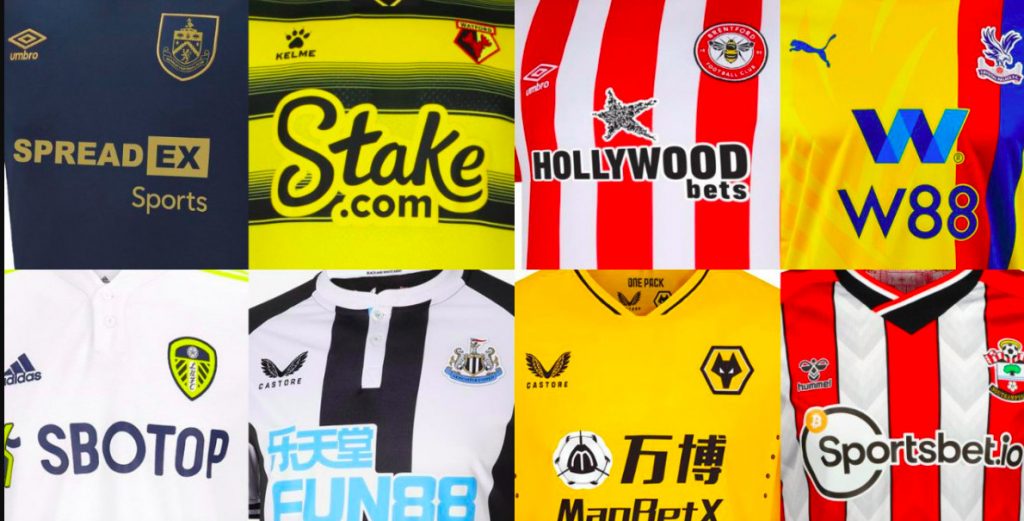
One big reason betting brands remain so heavily involved with the Premier League is the nature of the sponsors themselves. A large chunk of the companies whose logos appear on EPL shirts aren’t really targeting British punters at all — their focus is firmly on international markets.
As a result, the Premier League has effectively become a global advertising platform. That front-of-shirt logo isn’t primarily about reaching UK fans anymore; it’s a powerful tool for pushing brands into export territories. That’s exactly why, even as domestic regulations tighten, betting operators still see real value in those club sponsorship deals: the commercial payoff from the Premier League stretches way beyond Britain’s borders.
How the White-label Model Works in Betting
A lot of these sponsorship agreements are signed with brands that operate on a white label basis. On paper, they’re licensed and run through regulated British operators, but in reality they’re fronting for international platforms — often ones that can’t (or choose not to) get a UK licence themselves.
The British-regulated entity acts as the “face” that satisfies Premier League and FA rules, while the actual product, customer base and profits are tied to offshore or overseas operations.
Why Asia Remains the Key Target Market
For a significant number of these brands, Asia is still the priority. The Premier League’s truly global viewership gives them exactly the reach they need, and the sheer scale of international broadcasts (especially in places like Southeast Asia, India and the Middle East) massively amplifies the exposure.
A single logo on a Manchester United or Liverpool shirt can be seen by tens of millions of potential customers in markets where online betting is huge and growing fast — far bigger potential than the UK domestic market alone.
The Premier League as a Global Shop Window for Operators
At this point, the Premier League isn’t just a football competition — it’s one of the most effective international marketing platforms on the planet. The club gets a chunky sponsorship cheque, the operator gets direct, high-visibility access to a worldwide audience that’s difficult (and expensive) to reach any other way.
Even with front-of-shirt logos disappearing from 2026/27 in the UK, that global shop-window effect isn’t going anywhere. The value of being associated with the Premier League’s massive international following keeps betting companies coming back — they just adapt the way they show up.
Risks for Clubs: Falling Contract Values and the New Financial Controls
The financial fallout from the ban won’t just come from losing one visible advertising slot. It will also show up in the lower overall value of commercial deals — especially now that the Premier League is tightening the screws on spending through stricter financial rules.
Squad Cost Ratio and the Mounting Budget Pressure
From 2026/27, the Premier League switches to its updated financial controls system, with the Squad Cost Ratio (SCR) becoming the main benchmark. In simple terms, SCR measures how much of a club’s revenue is being spent on the playing squad (wages + transfer amortisation + agent fees).
The rules are designed to keep spending sustainable: clubs can’t let squad costs eat up too big a slice of their income.
Potential 20–30% Drop in Sponsorship Income
If the front-of-shirt ban ends up reducing the value of those contracts by 20–30% (which many industry insiders consider a realistic range), clubs outside the top six will face real trouble trying to stay compliant under the new SCR limits.
For teams that already run tight budgets and rely heavily on betting money, even a moderate dip in commercial revenue could push them dangerously close to — or over — the allowed thresholds.
What Clubs Will Actually Have to Do
Faced with lower income and stricter spending controls, the realistic options boil down to a few tough choices:
- Trimming the wage bill — cutting player salaries, offloading high earners, or being far more cautious with new contracts
- Selling key players — cashing in on star assets to balance the books and generate transfer profit
- Slowing down investment — delaying stadium upgrades, academy spending, or other long-term projects
- Hunting for replacement sponsors — scrambling to bring in new partners from non-gambling sectors (tech, finance, fashion, energy drinks, etc.), though these deals are usually harder to land and often pay less than the betting ones they replace
For the clubs most exposed — especially those in the bottom half of the table who’ve leaned heavily on bookmaker cash — it’s not just about replacing one logo. It’s about rethinking entire commercial strategies under much tighter financial handcuffs than they’ve had to deal with before.
Why the EFL Will Remain Heavily Dependent on Gambling Sponsorship
When you zoom out and look at the whole English football pyramid, the picture becomes clear: the Premier League’s front-of-shirt ban isn’t some grand, system-wide break with betting companies. It’s a very targeted tweak that only really affects the very top tier. Down in the lower leagues, the economic model stays pretty much the same — and it’s far more fragile and exposed.
Unlike Premier League clubs, which can lean on massive global commercial deals, TV money and international fanbases, Championship, League One and League Two sides have almost no equivalent reach. Their commercial income is much thinner, and they rely far more heavily on centralised league-wide sponsorships to keep the lights on.
The EFL’s title sponsorship with Sky Bet is still worth roughly $54.6 million a year, split between all 72 clubs in the Championship, League One and League Two. That money is a lifeline — for many of these teams it represents a chunky slice of their entire budget.
In contrast to the Premier League, where individual clubs can negotiate their own big-money front-of-shirt deals (often with international white-label brands), EFL clubs don’t have that luxury. The league negotiates one big central deal, and the cash gets divvied up. Losing or seriously weakening that would be catastrophic for a lot of them.
The Growing Gap Between the Premier League and the EFL after the Ban
The Premier League’s decision to ditch front-of-shirt betting logos from 2026/27 doesn’t create a clean break between English football and the gambling industry. It just highlights how uneven things already are.
The top flight can afford to wave goodbye to that particular format because it has so many other revenue streams — global TV rights, massive commercial portfolios, matchday income, merchandise around the world. The EFL simply doesn’t have those buffers. For the 72 clubs below the Premier League, gambling sponsorship (especially the central Sky Bet deal) remains one of the few reliably big pots of money coming in.
So while the Premier League takes a visible step away from betting logos on shirts, the lower leagues stay locked in — financially dependent and with far fewer alternatives to turn to if that sponsorship ever dried up. The ban might look like progress at the elite level, but down the pyramid the reliance on gambling money is as strong as ever.
Structural Dependency: How Deeply English Football Is Tied to Betting
To really grasp what’s going on here, we need to step back from the headlines about one specific ban or one particular advertising spot. This isn’t just about logos disappearing from shirts. It’s about decades of deep financial integration between the betting industry and the entire economy of English football.
Over $1.5 Billion a Year in Advertising and Sponsorship
Licensed gambling operators in the UK collectively spend more than $1.5 billion annually on advertising and sponsorship deals. And football — by a very wide margin — remains the single biggest beneficiary of that money.
TV ads during matches, pitchside hoardings, shirt sponsorships, training-kit deals, stadium naming rights, official betting partners, digital campaigns — the list is long, and football gets the lion’s share.
Football as the Primary Destination for Betting Investment
So the conversation has long moved past “should logos be on shirts?” It’s now about the systemic economic link between the sport and the gambling sector. Betting companies aren’t just sponsors; for large parts of the pyramid they’ve become structural partners — helping pay wages, fund transfers, keep stadiums running, and in some cases literally keeping clubs afloat.
Bottom Line: Will the Money Vanish along with the Logos?
The 2025/26 season marks the peak of the EPL’s overt dependence on bookmaking contracts in a format that will soon be formally banned.
The chest logo will disappear. However, the financial architecture will likely remain. The main question is whether the competitive balance of English football will change or whether the transformation will merely be a redistribution of advertising inventory between formats.
The 2026/27 season will be the first test for the new model.