

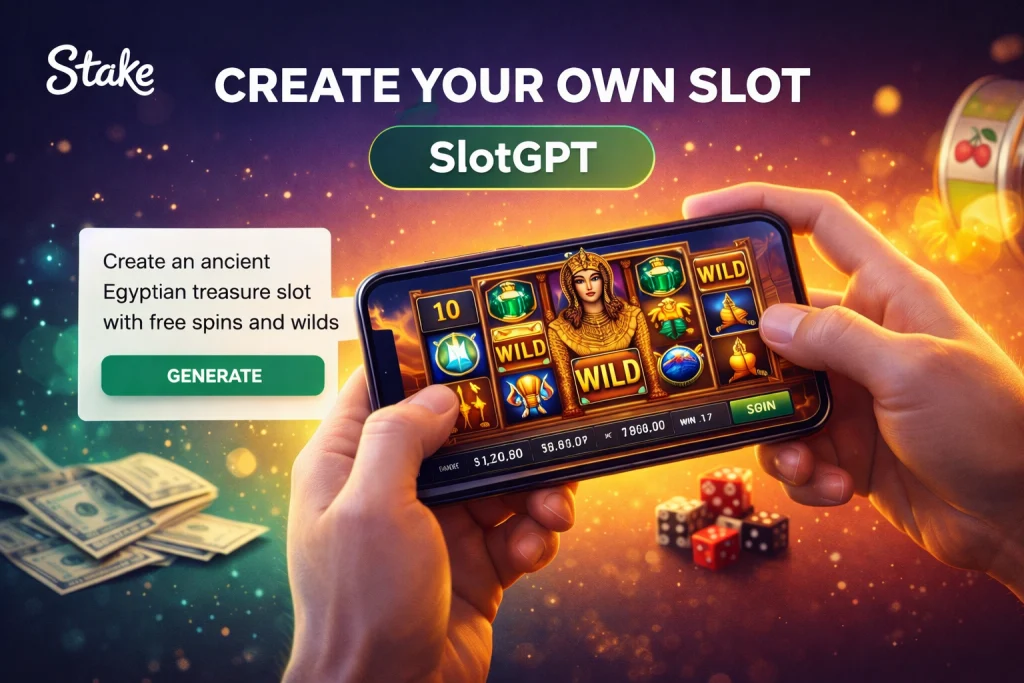
In late December 2025, Stake introduced SlotGPT — a tool that reshaped the player’s role. For the first time, a mass audience gained the ability not only to play slots but to create them. Users simply enter a short text prompt, and within minutes the system generates a fully functional slot machine available for real-money play.
The announcement spread rapidly across the industry. During the first ten days, headlines featured bold claims about the “end of providers” and a “new era of content.” As the initial hype faded, the situation began to reveal a far more complex and intriguing picture. What does SlotGPT represent today, what does it actually offer, and does the future of the industry truly belong to AI-generated content? Let’s take a closer look.
What Is SlotGPT?
SlotGPT is not a standalone game but a platform integrated into Stake. Users define a theme, style, or concept, after which AI generates a slot complete with visuals, symbols, audio, and core gameplay logic. Key mathematical parameters remain fixed:
- RTP 96%
- Maximum win x5000
Users cannot modify the mathematical model. This distinction matters. Players control the presentation layer but not the payout structure.
Metrics: Launch and Growth
Public data on SlotGPT primarily came from industry media and press releases:
- The platform generated nearly 27,000 games in its first weeks
- Later reports referenced approximately 39,500+ slots
- Total published games exceeded 40,000
- Average generation reached roughly 1,700+ games per day
- Moderation rejected about 20% of prompts
From a UGC perspective, these figures appear strong. However, search-demand analysis paints a more restrained picture.
Google Trends for the keyword Stake showed no abnormal spike on release day. Queries related to SlotGPT also remained relatively modest. This pattern aligns with typical industry hype, where intense internal discussion does not necessarily translate into mass-market interest.
SlotGPT quickly proved to be a highly effective marketing mechanism.
- Novelty effect. The ability to “create a personal slot” functions as a powerful attention trigger.
- Lower entry barriers. Users shift from players to creators without design or development skills.
- Viral mechanics. User-generated content naturally fuels sharing, streaming, and community engagement.
In practical terms, Stake unlocked an effectively unlimited stream of experimental content without relying on traditional development cycles.
SlotGPT Limitations and Structural Weaknesses
Despite its visual flexibility, SlotGPT does not affect the most critical component of a slot — its mathematics. A slot machine primarily operates as a complex system built around:
- Payout distribution
- Volatility balancing
- Trigger frequency
- Retention mechanics
- RTP
- Behavioral dynamics
This layer is where providers create long-term product value. AI can assemble the presentation quickly, but it cannot replace years of optimization, behavioral modeling, and advanced monetization frameworks. As a result, most generated games tend to replicate familiar structures rather than introduce deep mechanical innovation.

Key Platform Risks
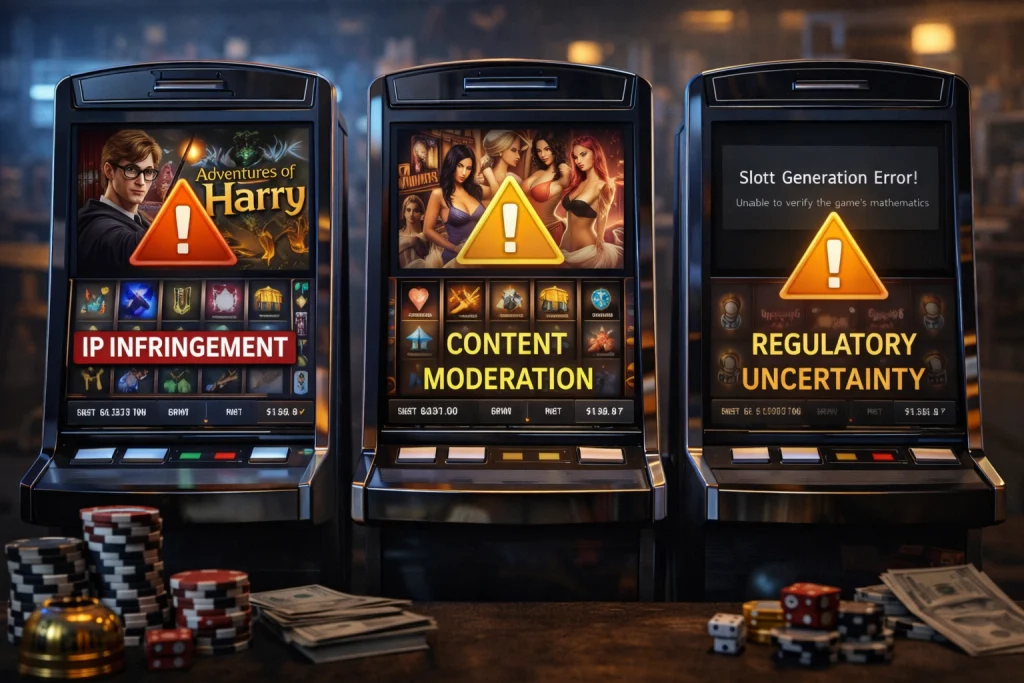
Almost immediately, users began generating games that visually resembled well-known brands, characters, and franchises. Even when AI produces formally “original” content, the risk of IP conflicts remains high. This challenge represents a structural issue for any UGC-driven ecosystem. Beyond intellectual property concerns, the iGaming space faces several additional risk factors.
Regulatory Uncertainty
SlotGPT introduces a new product category — user-generated gambling games. This shift raises fundamental questions. Who holds legal responsibility for the content? How does certification apply to fixed mathematical models? How should regulators approach moderation frameworks and permissible themes? In regulated markets, such mechanics will inevitably attract regulatory scrutiny.
Gameplay Quality
High-volume generation does not guarantee strong design standards. Large-scale UGC environments typically struggle with repetition, visual overload, and the absence of carefully structured game economies.
Responsible Gaming
Personalization and the perception of “owning” a product may increase emotional engagement. That dynamic requires careful evaluation, particularly when viewed through the lens of behavioral risk and responsible gaming frameworks.
SlotGPT — A Threat to Providers?
In short, not at this stage. SlotGPT does not compete directly with leading developers but instead shapes a new niche centered on experimental UGC content, creativity, and novelty-driven engagement. Traditional providers continue to dominate key segments:
- High-budget AAA slots
- Advanced mechanics
- Jackpot systems
- Long-term retention and LTV models
AI-driven generation does not replace industrial game development; it currently operates alongside it.
What Did SlotGPT Actually Change?
The most significant shift did not occur within slot mechanics but within the industry’s UX logic. AI moved beyond its traditional role as a back-office tool and became part of the player-facing experience. Users now move from pure content consumption toward direct participation in content creation. This transition represents a meaningful strategic marker for the market.
Can AI Truly Transform iGaming?
AI no longer appears as an experimental technology. The industry increasingly treats it as a functional “junior specialist” within operational structures. Algorithms monitor user behavior, process large-scale datasets, support decision-making, and automate repetitive workflows, while human oversight remains the defining condition.
AI delivers the strongest impact in environments characterized by high operational volume and relatively controlled risk:
- Customer support
- Anti-fraud systems
- Audience segmentation
- Dynamic interface personalization
Industry priorities have gradually shifted from cost optimization toward “digital empathy,” where systems adapt to player behavior without undermining trust or perceived human-centered interaction.
At the same time, strategic tension between regulation and innovation continues to intensify. AI already operates within KYC, AML, and retention frameworks. Excessively restrictive regulatory structures may slow technological adoption and redistribute competitive advantages toward less regulated markets.
Hyper-personalization introduces a dual effect. Algorithms can substantially increase engagement, yet within gambling ecosystems this dynamic may elevate audience fatigue risks and require more cautious interaction models.
Automation also reshapes the industry’s structural landscape. Processes that previously required large operational teams increasingly migrate toward compact AI-driven systems, driving demand for new competencies, specialized AI solutions, and deeper internal technological expertise.
Final Assessment
SlotGPT represents both a technological and marketing experiment. Despite several debated aspects, the platform clearly signals emerging industry trends.
The advantages stand out:
- Strong media impact
- High UGC activity
- Significant viral potential
- Perception of technological leadership
Limitations and weaknesses remain equally visible:
- Fixed mathematics
- Limited mechanical depth
- Intellectual property risks
- Regulatory uncertainty
- Inconsistent content quality
SlotGPT will most likely establish itself as a niche format within the Stake ecosystem — dynamic and engaging, yet not disruptive to the traditional provider model. More importantly, the emergence of such tools highlights a broader shift. iGaming continues to move toward an era of AI-driven interactivity, where the boundary between player and developer gradually becomes less defined.