
At the end of 2025, Trust Wallet took a major step towards becoming a proper trading hub by launching the Predictions section directly inside its mobile app. The idea is straightforward: users can not only store tokens or make swaps but also trade probabilities on real-world events — from elections and military conflicts to Bitcoin price movements — all without leaving the app or connecting to external dApps.
The first stage was integration with the Myriad protocol. Just a few months later, the company announced full integration with Polymarket — the world’s leading crypto-native prediction market platform. As a result, users now get cross-chain access to events across 12+ networks, including Ethereum, Polygon, and Arbitrum. The key innovation is the truly seamless experience:
- Myriad and Polymarket markets are merged into one unified interface
- Events from different chains appear in a single feed
- The system automatically selects the right asset for buying shares, cutting down on confirmations and gas fees
In the first few months, trading volume inside the Predictions section surpassed $100 million. Against the backdrop of the prediction market boom (Polymarket alone handled tens of billions in global volume in 2025), the move feels completely logical and timely.
Polymarket: Licence and Legality
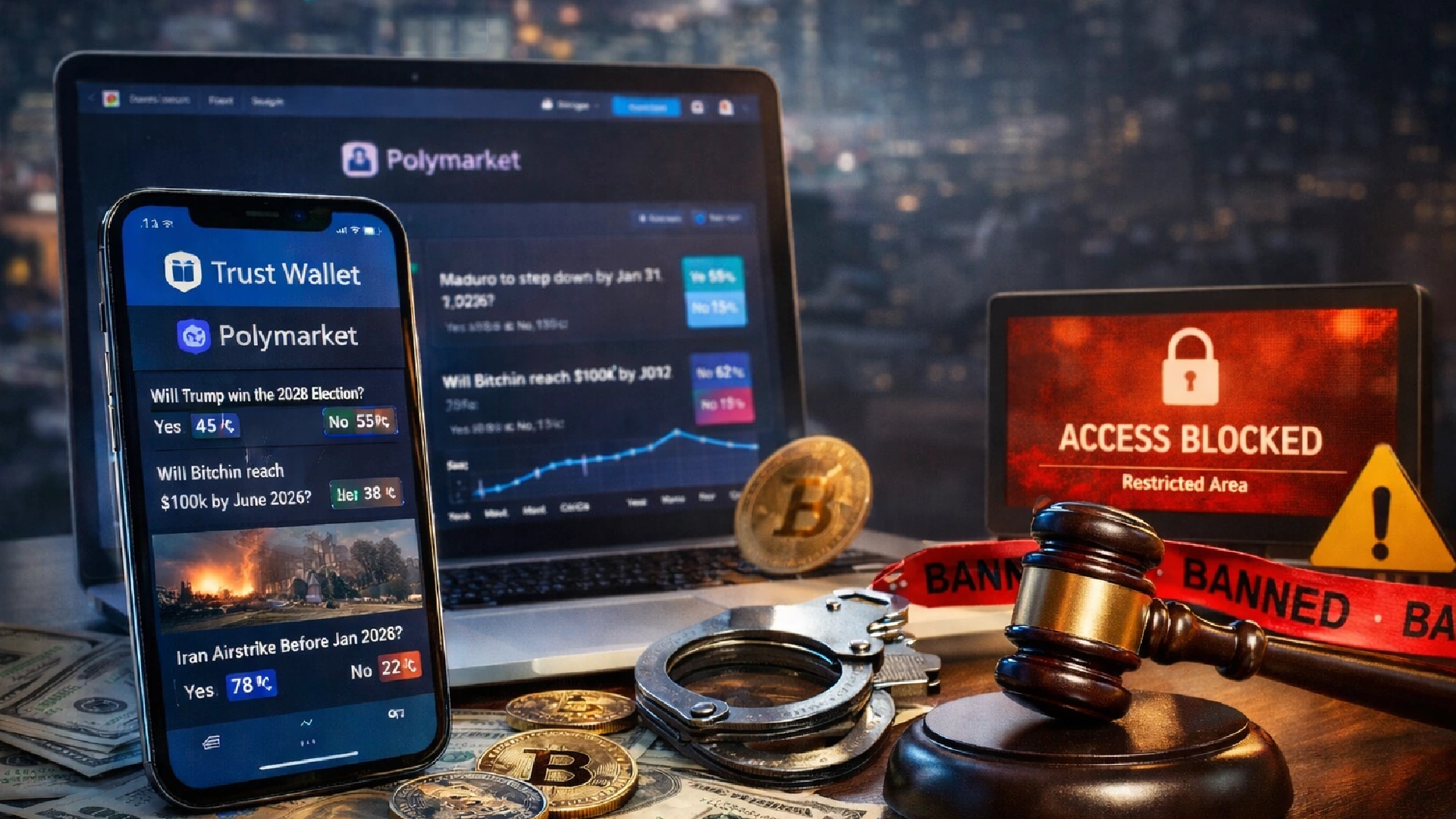
Polymarket positions itself as the world’s largest decentralised prediction market. Users buy “yes/no” contracts priced between 0 and 1 dollar — essentially trading the collective probability of an event. If the outcome happens, the contract pays out $1; if not, it goes to zero.
In 2025 the company acquired the licensed exchange and clearing firm QCEX for $112 million, securing CFTC approval and formally re-entering the US market. However, as of early 2026, actual access for American users remains restricted (via a waitlist or intermediaries). The platform is clearly pushing hard towards institutionalisation, yet this is exactly where the biggest paradox emerges. The more liquidity and attention it attracts, the stronger the wave of international bans.
When Predictions Become a Problem: Insider Trading Scandals
The surge in liquidity and visibility inevitably led to major controversies.
Israel and bets on military action
In June 2025, an unknown trader (account ricosuave666) placed tens of thousands of dollars on the exact timing of an Israeli strike on Iran. After the operation began, the bet yielded around $128–150k in profit. Later the same account successfully predicted several more military events. Israeli security services (Shin Bet) launched an investigation, suspecting the use of classified information. In February 2026 two people were arrested and charged with serious offences, including using secret military reports for Polymarket trades.
Venezuela and $400k in a single day
In January 2026, a new account (Burdensome-Mix) wagered roughly $32.5k that Nicolás Maduro would leave the presidency by the end of the month. Following his arrest/capture by US forces, the bet closed with over $400k in profit (a return exceeding 1200%). The account had been created just a month earlier, and all bets were exclusively on Venezuelan topics. The incident sparked huge political backlash in the US: Congressman Ritchie Torres introduced a bill banning government officials and civil servants from trading on prediction markets related to state policy when they have access to non-public insider information.
Additional noise came from a case where an analytics centre employee adjusted a conflict map right before Polymarket settled related contracts — allowing several traders to make astronomical profits that were clearly not down to luck alone.
Prediction markets have suddenly found themselves at the intersection of ethics, national security, and financial regulation. While Trust Wallet is building a super-convenient frontend for millions of users, regulators in Europe and beyond are responding with ever-harsher measures.
Wave of Bans: Portugal, Ukraine, Romania, and the Netherlands

While the US is still debating how (or whether) to regulate prediction markets, several European countries — and others — have already moved decisively and hard.
Portugal
In January 2026, the Portuguese gambling regulator SRIJ demanded that Polymarket immediately cease all operations in the country. The trigger was more than €103 million in bets placed on the presidential election. Particular scrutiny fell on over €4 million wagered in just a few hours before the official results were announced. Odds shifted dramatically in that window, raising clear suspicions of an information leak. The regulator classified the activity as unlicensed gambling and ordered full geo-blocking.
Ukraine
Back in December 202,5 the Ukrainian National Commission for the Regulation of Electronic Communications added Polymarket to the official list of prohibited websites. The formal reason given was “operating without a gambling licence”. Everyone understands the real driver, though: the platform’s active markets on military developments and the progress of the conflict. Under decision №695 the site is now fully blocked by Ukrainian ISPs . Access from UA IP addresses is cut off completely.
Romania
The National Gambling Office (ONJN) denylisted Polymarket as early as autumn 2025. ONJN President Vlad-Cristian Soare was blunt: “Blockchain is not a shield for illegal betting”. Romanian law treats such “counterparty betting” as a gambling activity that requires a licence — regardless of the underlying technology. Providers have been ordered to block access, and this forms part of a wider national crackdown on unlicensed crypto gambling.
Netherlands
In February 2026, the Dutch Gambling Authority (KSA — Kansspelautoriteit) issued one of its toughest enforcement actions yet. Polymarket must halt all activity in the Netherlands or face fines of €420,000 per week (capped at €840,000 total). Investigations showed Dutch IP users could easily register, deposit, and place bets — including on political events — without any licence. The KSA gave a four-week deadline to implement geo-blocking; after that, weekly penalties kick in automatically.
Today, Polymarket faces restrictions or outright bans in more than 30 countries worldwide.
Strategic Fault Line: Innovation vs Regulation
The Trust Wallet + Polymarket story is a perfect microcosm of a much bigger trend.
On one side, crypto wallets are rapidly evolving into full-fledged financial super-apps, and trading probabilities is emerging as an entirely new asset class. On the other hand, governments see prediction markets as gambling — especially when the events involve politics, elections, or national security — and treat them accordingly.
Prediction markets sit on a razor’s edge: part financial instrument, part crowd-sourced information signal, part online betting platform.
How to Bet on Polymarket in the UK
Today, Polymarket faces restrictions or outright bans in more than 30 countries worldwide, and the United Kingdom sits in a similar regulatory grey zone. The platform does not currently hold a licence from the UK Gambling Commission, meaning users connecting from UK IP addresses may only be able to browse markets in view-only mode.
In principle, however, the mechanics of participating in prediction markets remain straightforward. A user connects a Web3 wallet such as Trust Wallet or MetaMask, funds it with USDC (usually on the Polygon network), and purchases “Yes” or “No” shares priced between $0 and $1 that represent the market’s estimated probability of an event. If the predicted outcome occurs, the contract settles at $1; if not, it expires worthless.
Within Trust Wallet’s Predictions section, this process becomes even more streamlined, since Polymarket markets are integrated directly into the wallet interface alongside other trading features. At the same time, regulatory restrictions mean that practical access for UK users may still remain limited depending on compliance rules and regional controls.
What’s Next?
For Trust Wallet, integrating Polymarket is a clear move towards turning the wallet into a genuine Web3 trading centre — swaps, storage, NFTs, predictions, and potentially much more. For Polymarket itself, the partnership brings massive new user inflow and deeper liquidity.
But the future trajectory will hinge on one critical question: can the industry convincingly prove that prediction markets are a legitimate financial infrastructure of tomorrow, rather than just a decentralised bookmaker with extra steps?
One thing is already crystal clear: wherever money, information, and politics intersect, regulation will follow — and it’s coming fast.