

The United Kingdom has shifted its gambling reform framework toward a mandatory levy, replacing the long-standing model of voluntary industry donations. Policymakers introduced the levy to secure stable, independent, and transparent funding for research, prevention, and treatment programmes addressing gambling-related harm. The reform aims to eliminate uncertainty tied to discretionary contributions and to establish a predictable financial mechanism that supports long-term public health strategies.

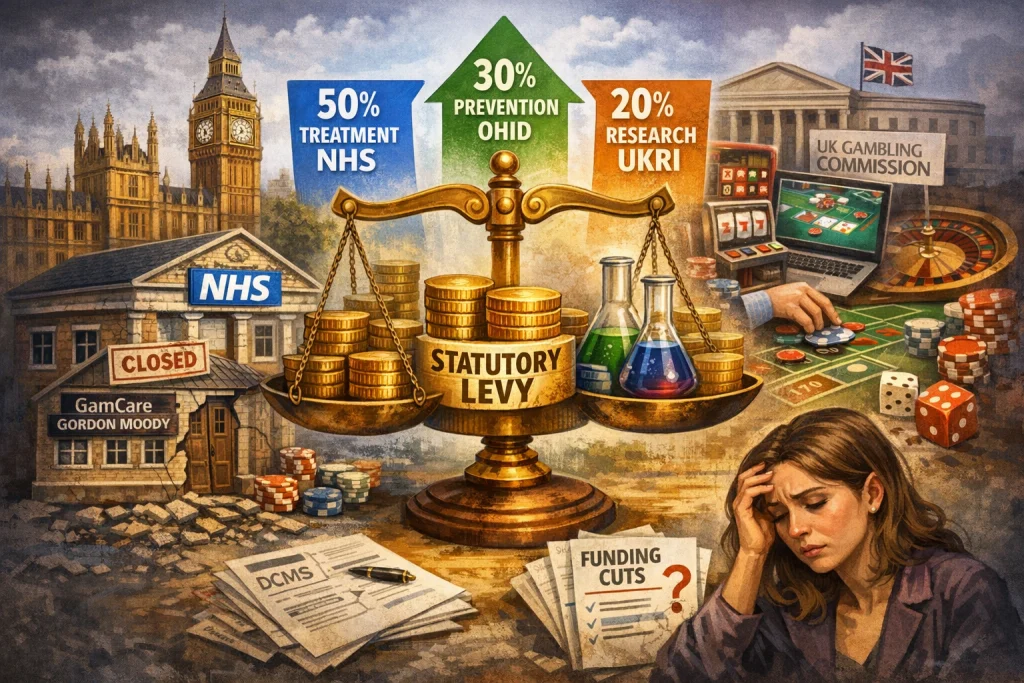
According to the 2024 government press release, the levy follows a fixed allocation model. The framework directs 50% of collected funds to the National Health Service (NHS) for treatment services. 30% to the Office for Health Improvement and Disparities (OHID) for prevention initiatives, and 20% to UK Research and Innovation (UKRI) for research programmes. Contribution rates vary by sector:
- 1.1% of Gross Gambling Yield (GGY) for online operators
- 0.5% for land-based bookmakers
- 0.2% for casinos operating gaming machines
- 0.1% for family entertainment centres
Licensed operators must pay the levy to the UK Gambling Commission (UKGC). Department for Digital, Culture, Media and Sport (DCMS) sets both the rates and the distribution structure.
The levy replaces the previous voluntary system, under which GambleAware served as the primary funding recipient. During the 2018–2019 period, voluntary contributions generated approximately £9.6 million, representing roughly 0.1% of GGY. In contrast, the new mechanism projects annual funding levels between £100 million and £120 million.
Under the NHS, OHID, and UKRI management structure, the model aims to deliver greater financial independence and remove direct reliance on discretionary industry donations.
“The Silence Crisis” of Mandatory Levy
Major treatment providers Gordon Moody and GamCare raised the first alarms. In October 2025, both organisations sent a letter to the government stating that they lacked clarity on funding after March 2026. They warned that without interim financial support, many support services would face insolvency.
GamCare CEO Victoria Corbishley told The Guardian that service providers “do not know what is expected of them” after April. She stressed that ongoing uncertainty already disrupted operational planning. A Gordon Moody representative echoed the concern, noting that the reform had left long-established and experienced organisations in a prolonged state of instability, with visible consequences for frontline services.
By December 2025, Gambling Minister Baroness Twycross reaffirmed the government’s commitment to a “smooth transition.” The new system is stated to expand and strengthen existing harm reduction efforts. Official reassurances, however, failed to calm the sector. Numerous organisations began reducing staff numbers, while some programmes halted operations entirely.
In February 2026, journalists citing industry sources reported that several charities approached structural collapse. Operators continued paying the levy, yet the distribution mechanisms remained incomplete, prolonging financial uncertainty across the treatment and prevention ecosystem.
Mandatory Levy: Ideological Barriers
The reform quickly encountered disputes over independence standards. Certain policymakers and activists argued that organisations with a history of industry funding carried reputational risks and should not participate in the new system.
In December 2025, Regulus Partners expert Dan Waugh warned that charities had become “caught in a squeeze of ideological purity.” Regulators discouraged them from accepting industry money — the same source that had supported treatment services for more than two decades — while NHS and OHID commissioners prioritised the expansion of state-managed programmes.
In January 2026, OHID circulated draft guidance suggesting that prior involvement in the voluntary funding framework could influence grant evaluations. Sector representatives interpreted this approach as a structural disadvantage for charities that had operated within the previous regime. Following strong criticism, OHID withdrew the provision on 30 January.
Despite the revision, the episode intensified tensions. Industry observers and charity leaders voiced concerns that policy interpretation, rather than funding mechanics alone, had begun shaping the stability of the third-sector support network.
Reactions and Public Debate
In January 2026, the House of Commons examined the rollout challenges linked to the mandatory levy. Lawmakers welcomed the potential to generate more than £100 million annually but warned about a looming “funding cliff.” Existing service agreements expire on 31 March 2026, while the new distribution system may not operate for several additional months. MPs urged the government to introduce interim financing and stressed that treatment and support services must continue without interruption.
Professional bodies and charities outlined their positions:
- GambleAware. The organisation endorsed the transition to a mandatory levy and confirmed a managed wind-down by 31 March 2026, noting that state institutions would assume responsibility for funding allocation.
- GamCare — The provider supported the levy framework but highlighted serious concerns about transition-period uncertainty and called for firm funding guarantees.
- Gordon Moody. Treatment specialists reported early reductions in service capacity and requested a 12-month interim funding arrangement alongside a comprehensive evaluation of all providers.
- BetBlocker and Deal Me Out. Representatives from both organisations stated in 2024 that the new model risked pushing charities to sever ties with the industry, potentially marginalising established third-sector groups.
Regulus Partners partner Dan Waugh also raised broader market concerns. He cautioned that the combined effect of higher industry taxation and stricter rules on funding sources could shrink the licensed market, stimulate black-market activity, and ultimately reduce total levy proceeds.
Structure and Governance of the New Levy
The UK Gambling Commission oversees levy collection, while DCMS defines the contribution rates and sets strategic priorities. The framework assigns NHS, OHID, and UKRI as commissioning bodies responsible for treatment, prevention, and research funding.
In 2025, DCMS established a Programme Board that brought together representatives from multiple government departments alongside officials from Scotland and Wales. The Board assumed responsibility for supervising fund allocation and ensuring that the levy supports its core objectives — expanding research capacity, strengthening prevention programmes, and scaling treatment services.
Additional Measures Within the Gambling Reform
From September 2024, stake limits on online slots entered the market for the first time. The rules cap wagers at £5 per spin for players aged 25 and over, and at £2 for young adults aged 18–24. Policymakers justified the lower threshold for younger players by pointing to elevated vulnerability to gambling harm and lower financial resilience. These restrictions complement the mandatory levy and directly target harm reduction.
The Premier League also committed to reducing gambling advertising visibility. Clubs agreed to remove bookmaker brands from the front of match shirts starting with the 2026/27 season. The decision reflects broader efforts to limit exposure rather than impose a statutory ban.
Earlier reforms had already reshaped the retail sector. In 2018, authorities reduced fixed-odds betting terminal (FOBT) stakes from £100 to £2 following sustained public and political pressure over gambling-related harm. Together, these measures illustrate a multi-layered regulatory strategy combining financial controls, advertising adjustments, and structural funding reforms.
What Does International Experience Show?
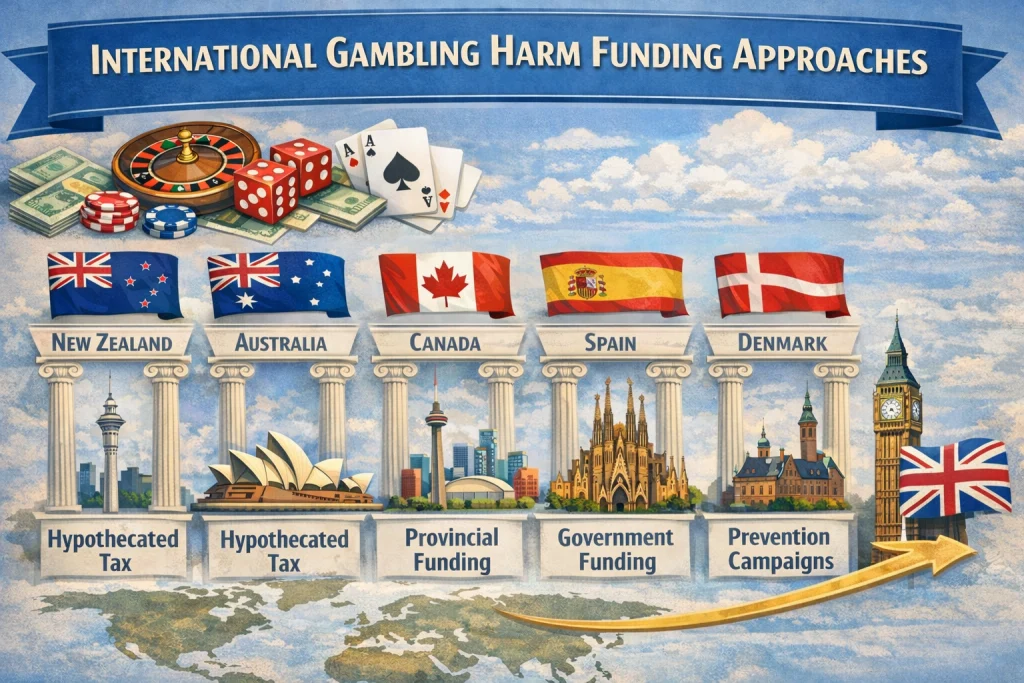
Regulated markets have relied on mandatory levy or targeted funding mechanisms for gambling harm reduction for years. Several jurisdictions illustrate how governments structure these models:
- New Zealand and Australia — Authorities apply hypothecated taxes that channel gambling-related revenue directly into prevention, treatment, and support services.
- Canada — Provincial governments finance harm-reduction programmes through general taxation, while allocating a defined share of gambling tax revenue to research and treatment initiatives.
- Spain — Funding flows from the central budget. The state-controlled operator directs part of its profits toward prevention and treatment strategies.
- Denmark — The national regulator supports public awareness and harm-prevention campaigns through dedicated funding mechanisms.
These approaches demonstrate that mandatory contributions and earmarked taxation have become standard regulatory tools across multiple countries. By introducing its own levy framework, the United Kingdom aligns with well-established international policy trends.
Mandatory Levy: Final Perspective
The British gambling harm-reduction framework now faces an unusual paradox. The mandatory levy represents a structural milestone and moves the country closer to widely adopted international models.
At the same time, weaknesses in the transition process, policy friction, and delayed operational decisions have already placed substantial pressure on charities that historically formed the backbone of treatment and support services. The current turbulence highlights a critical reality: legislation alone cannot deliver effective public protection.
Sustainable outcomes require coordinated governance, clear funding mechanisms, and constructive collaboration between state institutions and experienced service providers. Without these elements, even the most ambitious reform risks undermining its own objectives and creating instability within the very system designed to reduce harm.