
In mid-February 2026, X (formerly Twitter) quietly — without any press release or public announcement — updated its Paid Partnerships policy. Gambling and betting have now been officially added to the list of categories prohibited from commercial integrations. On the surface, it’s just a change to a help-centre page. In reality, it’s a major strategic shift that rewrites the rules for gambling operators, affiliates, and influencers. Let’s break down exactly what happened and why it matters.
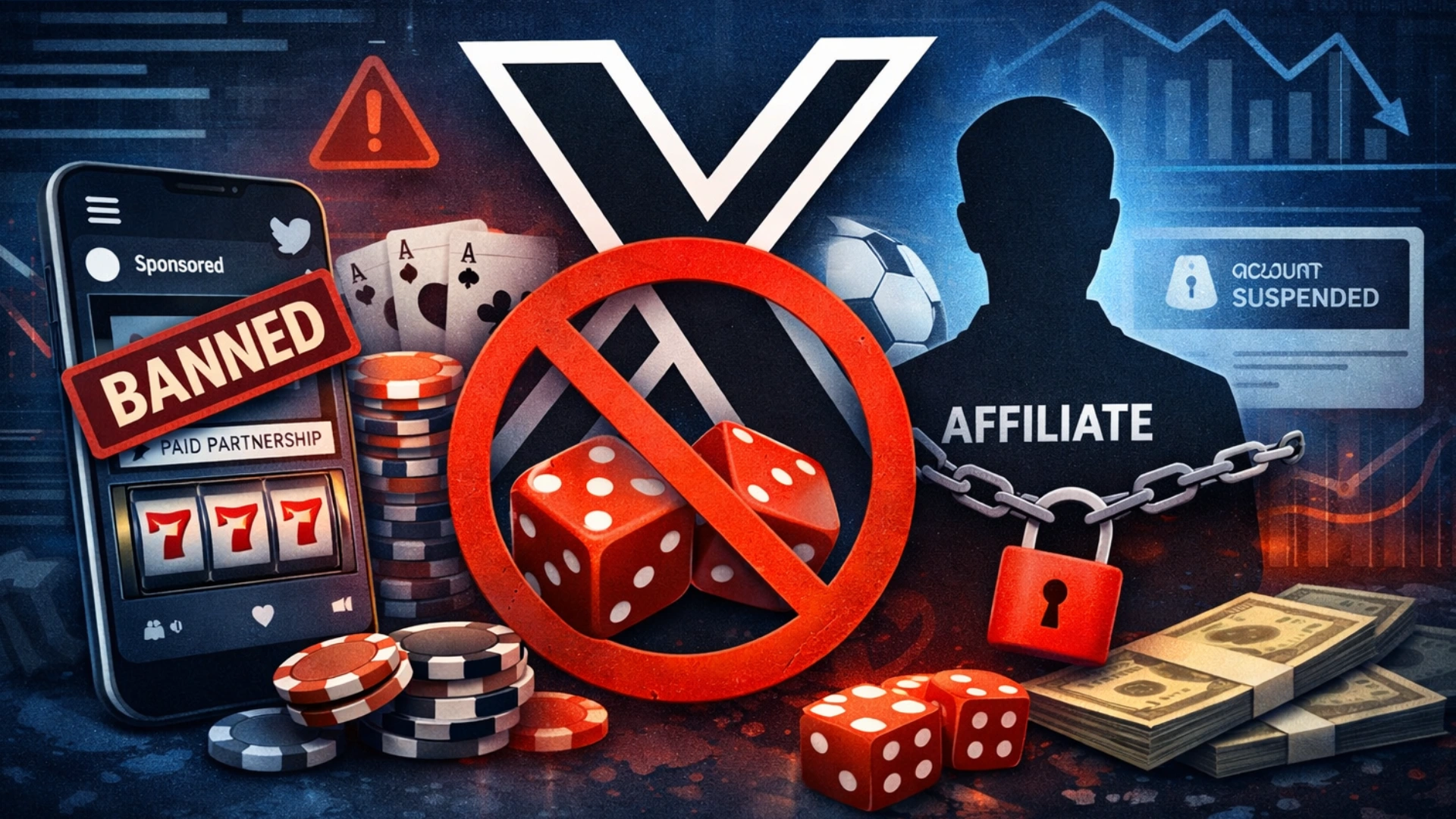
What Exactly Has Been Banned
First things first: X clearly distinguishes between two things:
- Paid Partnerships (organic posts made in exchange for compensation)
- X Ads (paid advertising run through the official ads manager)
The new ban applies only to the first format — organic integrations.
According to X’s official definition, a paid partnership is any collaboration in which a third party (a brand) provides the user with compensation or incentives in return for promoting a product or service. The help centre lists the typical signs of such a partnership:
- The product or service was gifted by the brand
- The user receives monetary compensation or other benefits for the promotion
- The post earns the author a commission on sales (for example, via an affiliate link or promo code)
- The author has a commercial agreement with the brand (e.g. ambassadorship)
Any post that qualifies as a paid partnership must clearly disclose its commercial nature (e.g. “Ad”, “#ad”, “Promoted Content”), and the user must comply with applicable advertising laws.
Here’s the critical point: even if the post is properly labelled as advertising, if it promotes a gambling service — it’s now a violation. This amounts to a complete ban on monetised organic integrations with casinos, sportsbooks, lotteries, and other gambling products.
Why This Is a Big Deal
X isn’t some niche platform. As of 2025 figures, it has over 550 million monthly active users. For iGaming, it had become one of the most important channels:
- Influencer-driven promotion
- Cross-traffic between Telegram and X
- Crypto-affiliate models
- Launching promo codes and partner links
That entire model is now broken.
For many operators, X was a genuine acquisition channel — especially for crypto casinos, offshore sportsbooks, betting aggregators, and tipster accounts. In practice, the platform has closed off the ability to earn from organic affiliate marketing in the gambling vertical.
Consequences and Sanctions
Violating the updated policy carries penalties. X states that when determining punishment, it takes into account both the severity of the breach and the account’s violation history. The minimum sanction is removal of the post plus a temporary restriction on posting. At the most serious end, it can lead to full account suspension.
Simply labelling the post as an advertisement won’t protect you if the content promotes a prohibited vertical. The X help centre also notes that repeated or serious violations can result in forced content deletion, temporary read-only mode, or permanent account deactivation for persistent offenders.
Can You Still Advertise via X Ads?
Yes. The Paid Partnerships policy is separate from the X Ads advertising policy. Gambling advertising through the official X Ads platform remains permitted, provided it meets these conditions:
- It is run in jurisdictions where gambling advertising is allowed
- It complies with local laws and regulations
- It receives prior approval from X
- It uses appropriate targeting (e.g. age and location restrictions)
In other words, X isn’t banning gambling outright — it is specifically closing off the grey-area organic monetisation channel that relies on influencers. Legitimate, platform-controlled advertising tools remain available for iGaming brands, but the informal “influencer-driven” paid-partnership traffic is now completely blocked.
Reasons Behind the Change and Broader Content-Control Trends
This update is part of a wider industry-wide tightening of controls around gambling content. In 2025, YouTube introduced stricter rules that prohibit creators from directing viewers to casino sites unless they are Google-certified or explicitly permitted under local law; the restrictions cover not only links but also logos and in-game interface displays. In January 2026, Google Ads further tightened gambling advertising requirements, demanding flawless compliance with both policy and domain rules. TikTok has been aggressively banning gambling integrations for some time already.
Platforms are increasingly looking to reduce their own regulatory exposure. Gambling remains one of the most sensitive verticals due to concerns around underage protection, addiction risks, regulatory scrutiny, and financial vulnerabilities. By removing the hard-to-moderate influencer channel, X has likely chosen to eliminate a major source of potential liability while preserving control over official paid advertising.
Who Will Be Hit Hardest?
Primarily affiliates. Most affiliate models rely heavily on referral links, CPA deals, and revshare structures. Organic traffic from X is now effectively toxic for these setups.
Crypto casinos will also take a serious blow. They have traditionally depended on influencers, meme content, viral posts, and promo-code drops — and X was particularly convenient for that kind of fast, low-friction acquisition. This ban represents a direct hit to their core growth model.
Tipster accounts are another obvious casualty. If they receive any form of commission from bookmakers, their posts now qualify as Paid Partnerships and fall under the ban.
What the Ban Will Lead To
Operators wishing to continue promoting on X will need to:
- Strictly separate organic brand content from any commercial integrations
- Shift budgets into official X Ads
- Strengthen internal compliance processes
- Diversify traffic sources more aggressively
Influencers, meanwhile, will have to rethink monetisation models entirely. We may see a short-term rise in grey-area workarounds, a migration of activity to Telegram, Kick, Discord, or other less regulated spaces, or a shift towards more tightly controlled advertising formats.
In the longer term, though, X appears to be betting on building a cleaner, more transparent advertising ecosystem.
Important reminder: you can still talk about betting odds, share analysis, discuss the industry in general — all of that remains allowed. What is prohibited is monetised integration.
Conclusion
The February 2026 update to X’s Paid Partnerships policy has formally banned all commercial integrations involving gambling and betting in organic posts. Paid shout-outs, gifted promo campaigns, referral links, and ambassadorship agreements are now prohibited for casinos, sportsbooks, and lotteries alike. Violators face content removal, temporary restrictions, or — in serious/repeated cases — full account deactivation.
These new rules will force operators and affiliates to pivot towards official X Ads (where gambling remains permissible under strict conditions), ensure full jurisdictional compliance, and accelerate the search for alternative promotion channels. Given the broader industry trend towards tighter regulation in iGaming and growing emphasis on responsible advertising, X’s decision looks like a logical step towards better user protection and lower platform risk.